Sunday, June 27, 2021

New study shows no risk to sperm from COVID-19 vaccine


A new study in the US has found there is no risk to a man’s sperm from having any of the currently available COVID-19 vaccines. 

The research, carried out at the University of Miami Health System, revealed that men may suffer a slight lowering of their sperm count for a few weeks as a possible side-effect but no more than they would following a viral infection.


“People should not be concerned. The vaccines are very safe,” said Co-author Ranjith Ramasay who had received over 500 emails from concerned men. 


Having tracked 45 men aged between 18 and 50, who had received the Moderna, Pzifer vaccine, and the mRNA vaccines, Ramasay concluded that there was no significant decline in their sperm count after 70 days.


He said that even though the numbers in the research were small, the researchers were confident they can generalise to the rest of the population.


He added that they were also confident that the Johnson and Johnson and the Novavax vaccines, which are yet to be authorised would also not affect sperm counts.


 “We are pretty confident, ” he avowed. 


Men were reported to be refusing to have the vaccine due to fears over trying to conceive, with many citing social media as their source of information.


Previously, studies said men who have recovered from COVID-19 may be at risk of developing low sperm count in the short term. 

Researchers from the University of Florence in Italy, analyzed semen samples from 43 men ages 30 to 65 about one month after they had recovered from COVID-19.

 They found that 25 percent of the men had low sperm count, and nearly 20 percent had azoospermia or the total absence of sperm in semen. 

It's much higher than the prevalence of azoospermia in the general population worldwide, which is around 1 percent, according to John's Hopkins School of Medicine. 

Also, participants with serious COVID-19 infections — those who were hospitalized or admitted to the intensive care unit (ICU) — were more likely to have azoospermia after their infection, compared with those who faced less serious infections, according to one study. 

However, the researchers stress their study doesn't prove that the COVID-19 virus harms sperm. They didn't measure the men's sperm counts before their infections, so can't say for sure if the counts declined post-infection. 

Africa faces fast surging COVID-19 3rd wave, says WHO


THE third wave of the COVID-19 pandemic is picking up speed in Africa as the continent faces its steepest surge yet, according to the World Health Organisation, WHO.

Africa is facing a fast-surging third wave of COVID-19 pandemic, the agency noted, with cases spreading more rapidly and projected to soon overtake the peak of the second wave the continent witnessed at the start of 2021.

The WHO Regional Director for Africa, Dr. Matshidiso Moeti, disclosed this on Thursday during a virtual press conference. said the worst may be yet to come for Africa if urgent steps are not taken to curb the current surge.

Since the onset of the third wave on 3rd May 2021,  COVID-19 cases have risen for five consecutive weeks. 

“The third wave is picking up speed, spreading faster, hitting harder. With rapidly rising case numbers and increasing reports of serious illness, the latest surge threatens to be Africa’s worst yet.

“Africa can still blunt the impact of these fast-rising infections, but the window of opportunity is closing. Everyone everywhere can do their bit by taking precautions to prevent transmission,” she noted. 

As of 20 June (day 48 into the new wave), Africa had recorded around 474,000 new cases, a 21 percent increase compared with the first 48 days of the second wave. 

At the current rate of infections, the ongoing surge is set to surpass the previous one by early July.

According to WHO, the pandemic is resurging in 12 African countries. A combination of factors including weak observance of public health measures increased social interaction, and movement as well as the spread of variants are powering the new surge. Across Africa, the Delta variant first identified in India has been reported in 14 countries.  

The COVID-19 upsurge comes as the vaccine supply crunch persists. 18 African countries have used over 80 percent of their COVAX vaccine supplies, with eight having exhausted their stocks, 29 have administered over 50 percent of their supplies. 

Despite the progress, just over 1 percent of Africa’s population has been fully vaccinated. Globally, around 2.7 billion doses administered, of which just under 1.5 percent have been administered in the continent.

As many high-income countries vaccinate a significant proportion of their populations, proof of vaccination is leading to fewer movement restrictions. Globally,16 countries are waiving quarantine for those with a vaccination certificate. Measures to prevent COVID-19 transmission are crucial, but with many African countries having limited access to vaccines, it is important that vaccines be only one of the conditions countries use to open borders and increase freedom of movement.

“With high vaccination rates, it’s shaping up into a summer of freedom, family, and fun for millions of people in richer countries. This is understandable and we all long for the same joys,” said Moeti. 

“Vaccine shortages are already prolonging the pain of COVID-19 in Africa. Let’s not add injury to injustice. Africans must not face more restrictions because they are unable to access vaccines that are only available elsewhere. I urge all regional and national regulatory agencies to recognize all the vaccines Emergency Use listed by WHO.”

In the European Union, a COVID-19 passport system for vaccination, testing, and recovery will take effect from 1 July. However, only four of the eight vaccines listed by WHO for emergency use are recognised by the European Medicines Agency for the passport system. 

 In Africa, most countries do not give quarantine exemptions for travellers who are fully vaccinated against COVID-19 and require a negative COVID-19 test.

Wednesday, June 9, 2021

COVID-19: China is vaccinating 20m people a day

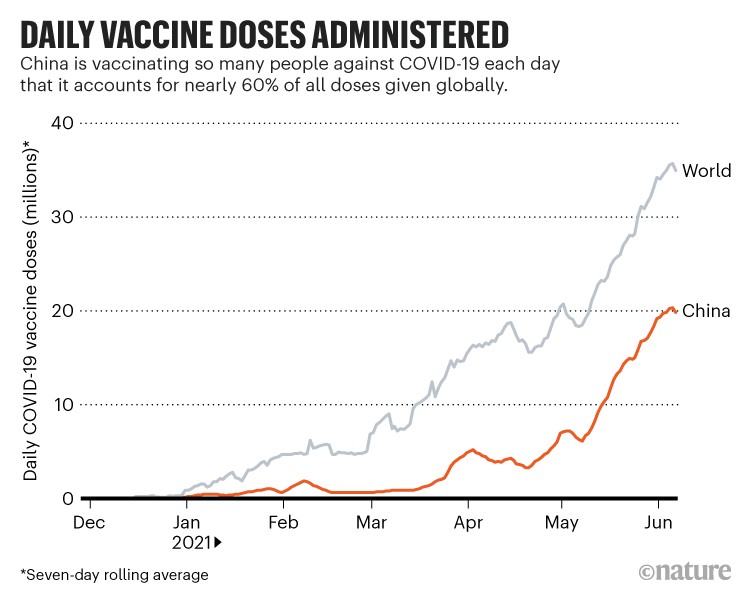
Daily vaccine doses administered: Chart showing China now accounts for nearly 60% of all COVID-19 doses given globally.
 For more than a week, an average of about 20 million people has been vaccinated against COVID-19 every day in China. At this rate, the nation would have fully vaccinated the entire UK population in about six days. 

China now accounts for more than half of the 35 million or so people around the world receiving a COVID-19 shot each day.

Zoltán Kis, a chemical engineer in the Future Vaccine Manufacturing Research Hub at Imperial College London, doesn’t know of “anything even close to those production scales” for a vaccine. “The manufacturing efforts required in China to reach this high production throughput are tremendous,” he says.

The majority of doses are of one of CoronaVac — produced by Beijing-based company Sinovac — showed an efficacy of 51 percent against symptoms of COVID-19 in clinical trials, and much higher protection against severe disease and death. The second jab was developed in Beijing by state-owned firm Sinopharm and has demonstrated an efficacy of 79 percent against symptomatic disease and hospitalization.

China’s current vaccine production rate could potentially make a significant dent in global demand, says Kis; that would be “a huge step in reducing the healthcare and economic burden of the COVID-19 pandemic”. 

China has already supplied 350 million doses of the two vaccines to more than 75 nations, and WHO approval should now trigger further distribution of both vaccines to low-income countries.

“China’s vaccination campaign got off to a slow start, but has rapidly picked up pace,” says Rongjun Chen, a biomaterials scientist also at the Future Vaccine Manufacturing Research Hub. As recently as mid-April, China was administering only about five million doses a day.

An official at China’s National Health Commission, said the nation aims to produce some three billion doses of COVID-19 vaccines in 2021 — and up to five billion per year after that.

To achieve such high production rates, many things need to go according to plan across the entire production and distribution chain, from sourcing raw materials to manufacturing active ingredients, filling vials and distributing doses to vaccination centres, says Kis. “It is crucial that everything arrives at the right location at the right time.”

Both CoronaVac and the Sinopharm vaccine are made from the inactivated virus. Scientists say that vaccines of this type require more time and effort to produce than do COVID-19 vaccines based on mRNA technology, such as the Pfizer or Moderna shots. To produce killed virus, manufacturers first need to grow it in living cells in large bioreactors, which can take months, explains Kis.

To achieve its massive gains, China probably leveraged its existing capacity for manufacturing inactivated-virus vaccines against other diseases, including influenza and hepatitis A, says Jin Dong-Yan, a virologist at the University of Hong Kong.

As of 6 June, China had administered 778 million doses to its population of about 1.4 billion people. At the current rate, it could fully vaccinate its whole population in around three months.

MERCK Foundation, ARCS partner to build fertility care capacity, advocacy in Africa


Merck Foundation and the Africa Reproductive Care Services, ARCS,  are partnering to build advocacy to break the stigma of infertility through awareness about infertility prevention and male infertility in Africa as part of Merck Foundation More than a Mother campaign.

Announcing the partnership, the CEO of Merck Foundation/President of Merck More Than a Mother, Senator, Dr. Rasha Kelej,  said it was a delight to partner with an important and inclusive Society like Africa Reproductive Care Society with the aim not to only provide scientific and clinics training to African doctors and embryologists but to also build advocacy to break the stigma of infertility and raise awareness about infertility prevention, management, and male infertility. 


“We at Merck Foundation partnered with 20 African First Ladies, Ministries of Health, Information, Education, Communication and Genders, Academia, Media & Art communities to achieve our goals to transform the landscape of fertility care in Africa, and we have achieved very important milestones. 

“I believe with our new partnership with ARCS we will continue our efforts and address different aspects of this topic”.

Also expressing elation at the partnership, the President of the ARCS, Prof Oladapo Ashiru, stated: “Merck Foundation has been creating awareness and building fertility care capacity in Africa. It is very critical to create awareness around infertility prevention and management as around 85 percent of infertility cases in Africa are caused by untreated infectious diseases, hence are preventable in many cases. 

“I also thank Merck Foundation CEO, Senator, Dr. Rasha Kelej for her energy, inspiration, and innovations. Together will do well for Africa.

“I invite all fertility care experts and embryologists, media experts, fashion designers who are our Merck Foundation Alumni to join this society. 

“Also, I invite policymakers, community leaders and members, singers and filmmakers to apply for the membership which is free and inclusive for all Africa”, Senator, Dr. Rasha Kelej added.

The partnership was announced during the 8th edition of Merck Foundation Africa Asia Luminary during the Fertility and Reproductive care session, where they provided scientific and medical training for more than 400 doctors from Africa and Asia. And, discussed challenges, strategies, and solutions to improve access to quality, equitable and regulated fertility care in Africa and Asia.

With “Merck Foundation More Than a Mother”, we have initiated a cultural shift to de-stigmatise infertility at all levels: By improving awareness, training local experts in the fields of fertility care and media, building advocacy in cooperation with African First Ladies and women leaders and by supporting childless women in starting their own small businesses. It’s all about giving every woman the respect and the help she deserves to live a fulfilling life, with or without a child. 

Ashiru said ARCS aims to be the foremost contributor and the partner of choice in advancing the ART care solutions and advocating for improving access to regulated and equitable fertility care solutions and breaking the stigma around infertility in Africa with a special focus on Sub- Saharan Africa.

Wednesday, May 26, 2021

Indian doctors fault distribution of unproven herbal COVID-19 remedy

Indian doctors have faulted the free distribution of an unproven remedy to COVID-19 patients by the state of Haryana as the maker of the herbal medicine faced a backlash over claims that modern medicine had caused deaths.

The northern state,  ruled by the Prime Minister Narendra Modi's Bharatiya Janta Party, said it would hand out the herbal drug Coronil to COVID-19 patients. 

The ayurvedic medicine was launched by yoga guru Baba Ramdev's company Patanjali Ayurved in 2020 as a COVID-19 cure.

The government later said the consumer goods company co-founded by Ramdev could not market the drug as a cure, and it needed to market it as an immunity booster.

But Ajay Khanna, the state secretary of the Indian Medical Association (IMA) who spoke in Uttarakhand, where Patanjali is headquartered, said there is no scientific basis to Coronil's use in treating COVID-19 patients. 

"If the Haryana government is doing this, then it is their loss. He (Ramdev) is more of a businessman than anything else. To sell his product, he has sparked a fight between allopathic medicine and ayurveda," Khanna said.

The Uttarakhand unit of IMA filed a lawsuit against the yoga guru, asking him to write an apology for his recent statement that science-based treatments had caused the deaths of thousands of COVID-19 patients.

The comment drew the ire of doctors across the country and Ramdev, who has a large following in India, withdrew his remarks weekend.

Ayurveda is an ancient Indian system that includes medicines, meditation, exercise and dietary guidelines practiced by millions of adherents.

The outcry over the remedy and the guru's comments comes weeks after Indian doctors warned against the practice of smearing cow dung on the body in the belief it will ward off COVID-19, saying there was no scientific evidence of its effectiveness and it risked spreading other diseases. read more

India's has had 27.16 million cases of the coronavirus and 311,388 deaths, according to health ministry data, and a devastating second wave of infections is sweeping many parts of the country.

Traditional medicine is popular with many people, partly because of a lack of access to healthcare, but doctors have warned of the danger of people putting their trust in alternative treatments for COVID-19.

"You lower your guard thinking you're protected in some way, but I think real harm can be caused by giving people a false sense of security," said Lancelot Pinto, a consultant pulmonologist at Hinduja Hospital in Mumbai.

A spoonful of miracle medicine made by a local Ayurveda practitioner Borigi Anandaiah, from some herbs and regular household ingredients like black pepper, cumin, honey, turmeric, neem, camphor, etc., was said to be preventing COVID-19, and curing the infection in patients providing better relief than the allopathy treatment.


SCI, GSK enhance COVID-19 response in Ikorodu with N38m medical equipment


AS part of the continuous efforts to support the  Lagos State Government to contain the COVID-19 pandemic in Lagos, support the frontline workers in their work on the pandemic, and sustain ongoing health care responses to the pandemic, Save the Children International, SCI, has donated response equipment valued at N38 million to the State government.

The donated equipment that includes Personal Protection Equipment, Infection Prevention and Control, IPC, commodities and medical oxygen devices, among others, are to be distributed to all the 28 primary health care centres and two General Hospitals in Ikorodu LGA of the  State.

The donation is aimed at ensuring availability of adequate oxygen therapy to patients with the infection, as well as under-five children with severe pneumonia in the State. 

Donation of the critical devices and commodities is made possible through the support of  pharmaceutical giant, GlaxoSmithKline,GSK, through the Integrated Sustainable Childhood Pneumonia and Infectious Diseases Reduction in Nigeria (INSPIRING) Project.
In the view of the Country Director, SCI Nigeria, Mercy Gichuhi,  Save the Children has worked with the Nigeria government to respond to the pandemic as a member of the COVID-19 Response Task Force at both Federal and several state levels and supporting the development and deployment of COVID-19 strategies to contain the spread of the disease.

She addded that SCI’s new partnership with GSK regarding COVID-19 prevention and control is a step further to catalyse change and contribute to an accelerated reduction in child deaths from pneumonia and other preventable infectious diseases.

“We are aiming to do more to support vulnerable children and families who have been hardest hit by the pandemic, Save the Children International remains committed to support the efforts of controlling and treating COVID-19 and pneumonia through our continued collaboration with the Lagos State Ministry of Health, ” Gichuhi noted. 

The Chief of Party INSPIRING Project, SCI Nigeria, Dr Isah Adamu, said: “It is very interesting to note that the INSPIRING Project was re-designed to provide room for interventions that support the government in fighting COVID-19 both in Lagos and Jigawa States. 
The project does not only supply medical and non-medical items alone but it is also strengthening the health system in 28 primary health cares and 2 general hospitals in Ikorodu Local Government of Lagos State.

"Ikorodu is one of the largest local government areas in Lagos State with various needs of community development intervention. We believe the donation will complement the preparedness and response of health care workers and also strengthen access to quality health care by the population."

He urged the Lagos State Government to take the lead to adopt the National Medical Oxygen Policy to drive state specific initiatives to ensure access and availability of medical oxygen in healthcare facilities in the State.

The Managing Director of GlaxoSmithKline Nigeria (GSK), Kunle Oyelana said  “During this pandemic, everybody has an important role to play to curtail the spread of the dreadful disease. It is key to us at GSK to partner with other organizations and governments to explore innovative ways to strengthen healthcare systems in communities while providing necessary support and materials to health workers to slow down the spread of the virus.”


Friday, April 2, 2021

Prof Ayodele Atsenuwa appointed Deputy Vice-Chancellor, Unilag


Professor Ayodele Atsenuwa of the Department of Public Law, University of Lagos, has been appointed the Deputy Vice Chancellor (DVC), Development Services, of the University.
Atsenuwa was appointed at the Statutory Meeting of the University Senate held on Monday, March 29, 2021, via an electronic voting process with 81 votes (63.28%).
She succeeds Professor Folasade Ogunsola, the erstwhile DVC. 
Prior to her appointment, Atsenuwa  was the immediate past Dean of the Faculty of Law. 
Renowned for her teaching and research interests in Criminal Law and Criminal Justice, Human Rights Law, Gender and the Law, Law and Religion as well as Health and Migration Law, her appointment has been met with widespread approval. 
Within the legal academia, Atsenuwa is widely respected for her initiatives aimed at bridging the gap between legal academics and legal practice and is acknowledged for her efforts at evolving more development-oriented law degree programmes in terms of content and teaching methodologies.
Her appointment is for two years, takes effect from Monday, March 29, 2021.

Treat women, not just fibroids — Ajayi

… HIFU milestone spearheads wider access to non-invasive care L-R: Founder/Managing Director, Nordica Fertility Centre and Fibroid Care ce...